How Much Does It Cost to Build in Tamworth in 2026?
If you’re hoping for one clean number, you’ll get bad advice.
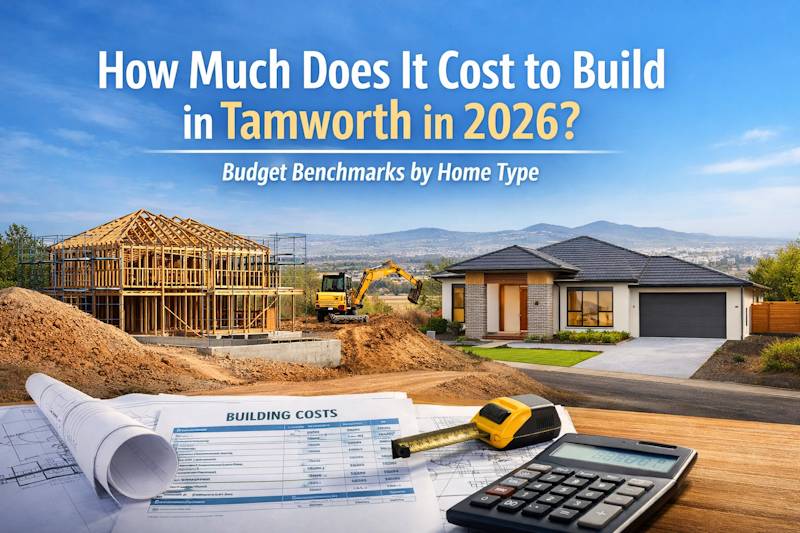
The cost to build in Tamworth per m² can vary dramatically — from around $1,700 per m² for a very simple project through to $5,000 per m² or more for high-end custom homes. That range alone explains why quoting a single “average build price” often creates more confusion than clarity.
In practice, build costs move most when the block and the scope are not properly defined early. Two homes with almost the same floor area can finish tens of thousands apart because one project had realistic site assumptions and the other was priced on optimistic allowances.
The useful question is not “what’s the average?”
It is “what will move my total cost up or down — and by how much?”
That is the question smart Tamworth home buyers ask before they choose a builder.
What actually changes the final number in Tamworth
A build budget usually shifts in four places: site conditions, documentation quality, inclusion level, and late decisions.
When any of those are vague, price certainty drops.
Site conditions
Slope, drainage paths, retaining needs, service connection complexity, and footing requirements all affect early allowances.
What this means for your budget: if site details are unresolved, fixed numbers are often only fixed for part of the project.
Documentation depth
Concept drawings are fine for early direction, but they are weak for accurate pricing. Better documentation creates better cost certainty.
What this means for your budget: the more complete the documents, the less guesswork gets priced in later as variations.
Inclusion baseline
Many quotes look cheaper because they include a lean baseline while another builder has priced a more realistic standard for kitchens, electrical, storage, or façade details.
What this means for your budget: compare quality-equivalent inclusions, not just totals.
Decision timing
The most expensive changes are usually made after contract, especially structural or service-related changes.
What this means for your budget: early decisions are usually cheaper decisions.
Planning ranges by project style
These are planning categories to help you frame conversations with builders and lenders. They are guides, not quotes.
- Entry-level family home: simpler footprint, practical finish level, tighter upgrade scope
- Mid-spec family home: balanced finish level, moderate façade and interior upgrades
- Premium or custom home: higher design complexity, elevated specifications, site-responsive detailing
In Tamworth, the same category can still vary materially depending on slope, access, and service constraints.
Two realistic Tamworth cost scenarios
Scenario 1: Flat estate block, first-home couple
They compare two similar single-storey quotes. Builder A is lower at first glance. Builder B is higher but includes clearer allowances for site works and external works.
They pick Builder B. They spend slightly more at contract stage, but fewer costs pop up later and final spend tracks closer to their planning number.
What this means: a higher-clarity quote can be safer than a lower headline quote.
Scenario 2: Sloping block near town fringe, growing family
They start with a standard plan and broad site allowances. Early engineering shows more retaining and drainage work than expected.
After adjusting layout and levels before final contract, they avoid major redesign during construction.
What this means: solving site response during design is usually cheaper than solving it on site.
Where budgets usually get caught out
Most cost pressure comes from items treated as later problems.
Common misses:
- External works such as driveway, fencing, and landscaping
- Service upgrades and connection complexities
- Drainage or retaining beyond base assumptions
- Electrical and storage upgrades discovered late
- Holding costs when programme timing stretches
If these are not discussed early, they still appear later, just at a worse time.
How to build a budget that survives reality
Good budgeting is less about guess precision and more about decision discipline.
1) Separate fixed scope from allowance scope
Know exactly which line items are fully documented and which are assumptions.
2) Normalise before comparing builders
Compare same plan intent, same inclusion quality, same site assumptions, and same external works scope.
3) Resolve high-impact decisions early
Finalise structural and service-sensitive decisions before contract where possible.
4) Keep a risk buffer for unresolved items
If some site or selection uncertainty remains, hold a project buffer proportionate to that uncertainty, not a random percentage.
FAQ: Build costs in Tamworth
What causes the biggest budget blowouts?
Usually the combination of under-scoped site works and late design or specification changes.
Is fixed-price enough to guarantee final cost?
Only for clearly documented scope. Allowances, exclusions, and client changes can still shift total spend.
Is a flat block always cheaper?
Often, but not automatically. Service access, drainage design, and planning constraints still matter.
Should I lock selections before contract?
For higher-cost selections, yes. It improves budget clarity and reduces variation pressure later.
Related pages
- Tamworth New Home Build Costs and Timeframes
- Home Builders Tamworth: Complete Guide to Building New in 2026
- Site Costs Explained for Tamworth New Home Builds
- What Is Included in a Fixed Price Build Contract
- Common Reasons New Home Budgets Blow Out and How to Avoid Them